PSA Birth Certificate Data Errors: How to Identify and Correct Them
Discovering an error on your PSA birth certificate can be an unsettling experience especially when you need the document urgently for a job application, passport processing, school enrollment, or an immigration requirement. A misspelled name, a wrong birthdate, or an incorrect entry for a parent’s name might seem like a minor issue on the surface, but in the eyes of government agencies and foreign embassies, even a small discrepancy can cause major delays or outright rejections.
The good news is that data errors on PSA birth certificates are more common than most people realize, and the Philippine government has established clear legal pathways to address them. Whether the mistake is a simple typographical error or a more substantial factual inaccuracy, there is a process in place and knowing how to navigate it can save you a significant amount of time, money, and frustration.
This guide walks you through how to identify errors on your PSA birth certificate, understand which type of correction applies to your situation, and complete the correction process step by step.
Why Birth Certificate Errors Happen
Before jumping into corrections, it helps to understand why errors appear on birth certificates in the first place. Most inaccuracies are not the fault of the individual; they typically originate at the point of civil registration, which for many Filipinos happened at birth, decades ago.
Common sources of errors include:
- Handwriting misinterpretation Hospital staff or civil registry personnel may have misread handwritten entries when encoding records into the system
- Typographical mistakes during encoding Manual data entry at the Local Civil Registry (LCR) level has historically been prone to clerical errors
- Inconsistent spelling of names Filipino names with regional variations or uncommon spellings are frequently entered incorrectly
- Late birth registration When a birth is registered long after it occurred, information is often supplied from memory or secondary sources, increasing the chance of inaccuracies
- Database migration issues When civil registry records were digitized and transferred to PSA’s national database, some information was transcribed incorrectly
Understanding the origin of the error can sometimes help you gather the right supporting documents to prove what the correct information should be.
How to Identify Errors on Your PSA Birth Certificate
The first step is obtaining a current copy of your PSA birth certificate and carefully reviewing every field. Many people only discover errors when another agency, a school, an employer, or an embassy flags a discrepancy between their birth certificate and another document.
Key Fields to Check
Go through each of the following fields thoroughly:
Personal Information
- Full legal name (first name, middle name, last name) check spelling and completeness
- Date of birth day, month, and year must all be correct
- Place of birth municipality, city, and province
- Sex male or female as registered
Parental Information
- Mother’s full maiden name
- Father’s full name
- Citizenship of both parents
Registration Details
- Date of registration
- Name of the attending physician or midwife
- Civil registry number and registration number
Annotations or Endorsements
- If the certificate has any annotations (e.g., for legitimation, acknowledgment, or adoption), verify these are accurate and complete
Comparing Against Other Documents
A practical approach is to cross-reference your birth certificate against other documents that contain your personal information:
- Passport
- PhilSys National ID
- School records
- Baptismal certificate (for older reference)
- GSIS or SSS records
Any mismatch between these documents and your birth certificate is a red flag that needs to be addressed before submitting your records to any government or immigration body.
Types of Errors and Which Law Covers Them
Not all birth certificate errors are corrected the same way. Philippine law draws a clear distinction between minor clerical errors and substantial changes, and each is governed by a different legal framework.
Minor Clerical or Typographical Errors Republic Act 9048
Republic Act 9048, known as the Clerical Error Law, allows for the administrative correction of obvious mistakes without going through the courts. This law covers:
- Misspelled first name or nickname
- Errors in the day or month of birth (but not the year, in most cases)
- Mistakes in the place of birth
- Errors in the mother’s or father’s name due to typographical errors
- Wrong sex entry due to a clerical mistake (covered under RA 10172 see below)
- Incorrect civil status of parents
This is the most straightforward type of correction and can be filed directly at the Local Civil Registry Office where the birth was originally registered.
Corrections to Day/Month of Birth and Sex:
Republic Act 10172 expanded the scope of RA 9048 to include:
- Errors in the day and month of birth (not the year)
- Errors in the entry of sex (male/female) when it is clearly a clerical mistake inconsistent with other entries in the document
This law also follows an administrative process and does not require a court order, provided the error is supported by sufficient documentary evidence.
Substantial Changes Rule 108 of the Rules of Court
Some corrections are considered too significant to be handled administratively. These require a judicial petition meaning you must file a case in court and obtain a judge’s order before the correction can be made. Errors that fall under this category include:
- Correction of the year of birth
- Change of surname (especially in legitimation or acknowledgment cases)
- Correction involving parentage (changing who is listed as the father or mother)
- Changes related to adoption or legitimation
- Any correction that affects civil status or citizenship
Court proceedings take considerably longer, often several months to over a year and typically require the assistance of a lawyer.
Step-by-Step Process for Correcting Minor Errors:
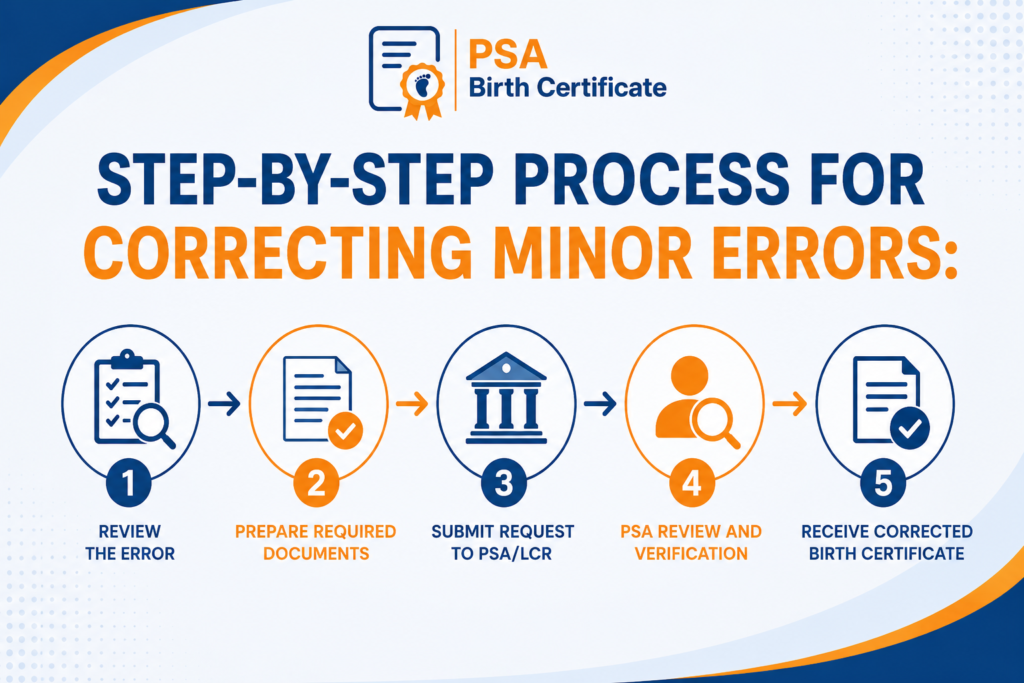
For most Filipinos dealing with a misspelled name or an incorrect birth month, the administrative PSA birth certificate correction process under RA 9048 or RA 10172 is the applicable route. Here’s how it works:
Step 1: Obtain a Certified Copy of Your PSA Birth Certificate
Before filing anything, secure a fresh copy of your PSA birth certificate. This will serve as the primary reference document throughout the process.
Step 2: Go to the Local Civil Registry Office
Visit the Local Civil Registry (LCR) of the city or municipality where your birth was originally registered, not just the nearest LCR to your current address. This is important because the correction must be processed where the original record is filed.
Step 3: Fill Out the Petition Form
Request and complete the Petition for Correction of Clerical Error form. Be specific about which field contains the error and what the correct information should be. The LCR staff can assist you in filling out the form properly.
Step 4: Gather Supporting Documents
This is often the most time-consuming part of the process. The documents you need to prove the correct information will depend on the type of error:
For name corrections:
- Baptismal certificate
- School records (Form 137 or diploma)
- Valid government-issued IDs
- Voter’s registration record
- Employment records
For date of birth corrections:
- Medical records from the hospital of birth
- Baptismal certificate
- School records showing the correct birth date
- Affidavit from the attending physician or midwife (if available)
For sex corrections:
- Medical certificate confirming biological sex
- Baptismal certificate
- School records
General requirements for all petitions:
- At least two or three public or private documents that consistently show the correct information
- Affidavit of publication (the petition must be published in a newspaper of general circulation for two consecutive weeks)
- Payment of filing fees
Step 5: Pay the Filing Fee
Filing fees vary by LCR but typically range from ₱1,000 to ₱3,000, depending on the type of correction and the specific local government unit. Additional fees may apply for publication and certification.
Step 6: Wait for Processing and Approval
Once submitted, the LCR evaluates the petition and supporting documents. If approved, they endorse the correction to the Office of the Civil Registrar General (OCRG) the PSA’s central civil registry office for annotation and updating in the national database.
Processing times vary but typically range from three to six months for the correction to be reflected in PSA’s database.
Step 7: Request a New PSA Birth Certificate
After the correction has been endorsed and processed by PSA, request a new copy of your birth certificate. The corrected copy will carry an annotation indicating the specific change that was made and the legal authority under which it was corrected.
What If You Were Born Abroad?
Filipinos born abroad whose births were registered with a Philippine Embassy or Consulate have their records maintained by the PSA under the Report of Birth system. Corrections to these records follow a similar administrative process but must be filed at the Office of the Civil Registrar General in Quezon City rather than a local LCR.
If you are currently abroad, you can coordinate the correction through the nearest Philippine Embassy or Consulate, though the process may take longer due to international mail and coordination timelines.
Tips to Speed Up the Correction Process
Navigating the civil registry correction system can be slow, but these strategies help move things along:
Compile your supporting documents first. The LCR evaluation depends heavily on the evidence you submit. The stronger and more consistent your documents, the faster the petition moves through the system.
Follow up regularly. After submitting your petition, ask the LCR for a follow-up schedule and check in at regular intervals. Government processing timelines can be extended if petitions are not actively monitored.
Keep copies of everything. Retain photocopies of all submitted documents, official receipts, and any communication with the LCR or PSA. These become important if your petition is questioned or delayed.
Hire a legal professional for complex cases. If your correction falls under Rule 108 or involves parentage, citizenship, or other sensitive matters, working with a lawyer from the start will save you time and prevent costly procedural mistakes.
Check PSA’s online portal after processing. Once your LCR confirms that the endorsement has been sent to PSA, monitor the database update by ordering a new copy through PSAHelpLine and verifying the correction is reflected accurately.
Frequently Asked Questions
Can I correct a birth certificate error if I’m currently living abroad?
Yes. You can initiate the process through the Philippine Embassy or Consulate in your country of residence. Expect longer processing times compared to filing directly in the Philippines.
Will the correction change my original birth certificate?
No. The original document is not destroyed or replaced. Instead, an annotation is added to the record indicating the correction, the date it was made, and the legal basis for it. Your new PSA copy will reflect the corrected information with this annotation.
Is there an expiration date on corrected birth certificates?
No, but many agencies require a copy issued within the past six to twelve months. After your correction is processed, request a fresh PSA copy to use for applications.
What if I discover the error while abroad and need the document urgently?
Contact the Philippine Embassy or Consulate immediately. In urgent situations such as a pressing immigration deadline explain your circumstances clearly. Some consulates can expedite certain endorsements, though administrative corrections still take time.
Final Thoughts
A data error on your PSA birth certificate is not the end of the road, it is a solvable problem with a clear legal process behind it. The key is identifying the error early, understanding which type of correction applies to your situation, and gathering the right supporting documents before you begin.
Acting proactively is always better than waiting until you’re under deadline pressure. Whether you’re planning an overseas application, updating your records for employment, or ensuring your documents are in order for future use, correcting errors on your civil registry records is an investment that pays off every time you need to present official identification. Start with a fresh copy of your birth certificate, review it carefully, and if something doesn’t look right take action sooner rather than later.